Introduction

Last updated: Feb 2, 2012  • 

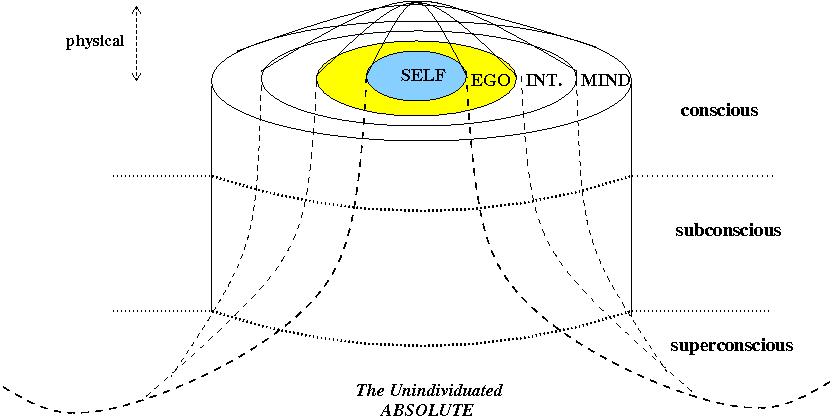
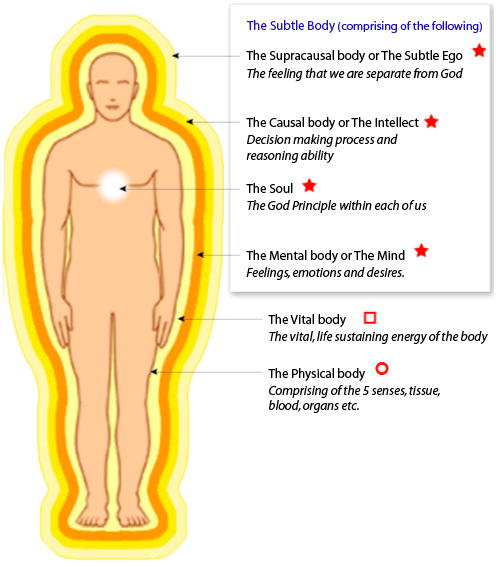
The human personality, in the Vedantic perspective, is a psychic complex, composed of the mind (manas, somewhat akin to Freudian Id), intellect (buddhi, akin to Freudian super-ego), the Ego (ahamkaara, akin to Freudian Ego) and the superconscious Self (aatman), or God principle in the individual. A subtle point is that the Self forms both the core (as "soul") and the substratum (as the "Higher Self") of the individual being. This paradoxical seeming assertion is rendered simple by referring to the geometric represention in the image to the left. More generally, the more inner a faculty at the conscious level, the farther and broader it extends as one plumbs to deeper layers of consciousness. (Thus the image on the right can be thought as a top-down perspective of the above depiction.)

In Vedanta, the Higher Self is the disinterested, witnessing meta-subject. It vivifies the ego and experiences its thoughts and feelings, and yet, paradoxically, does not influence the free choices of the latter nor is affected by the pleasure and pain experienced by the latter.
While agreeing with Freud's beautiful model in some respects, the Vedantic theory, as understood by Indian yogis since ages ago, posits many other details. One is that introduction of the superconscious level as the primary stage of individuation, beyond which there is a complete loss of structure as the individuals are resolved into an unindividuated Absolute, or brahman. The conscious personality, or ego self, may be thought of as a fraction of soul awareness projected by the Higher Self into the material plane in order to experience life as an individuated being under circumstances where the Veil of Material Nature (maya) shrouds the ego from its own cosmic origin and essential transcendental nature. One may call it a fundamental psychogical experiment to explore those possibilities of experience in this physical world, that would not be possible without the limitations that make us human.

So strong is the pull of the physical world and sensory environment that the ego self, equipped with free will, sometime in the past somehow became intensely entangled in its material life and increasingly oblivious of its agenda as soul. The momentum of past unfulfilled desires, attachments and false identifications drive the embodied ego to be born again and again until their motive momentum is exhausted. In the ego's transference from one physical body to another, only the subtle body accompanies it (image on the right hand side), with the physical body and the vital or pranic body, which is a sort of mind-matter glue, dropped off.

In the Path of Philosophical Contemplation, which is one of them and the topic of this page, Krishna reminds his friend Arjuna that one is in essense not the ephemeral physical body or even the moody ego self, but something else deep within, which does not sleep when the body goes to sleep, nor perishes when the life in the body becomes extinguished, but which remains a detached yet interested witness of the kaleidoscope of emotions and thoughts experienced by the ego. This Path should not be considered a form of otherworldly nihilism that denies the meaningfulness of the human body and life, but instead a calculated `reactionary' sting to awaken the human whose consciousness has been rendered obtuse through lifetimes of pleasure seeking that have programmed the mind to be so focused in the material as to become oblivious to its own glorious spirit aspect.

A quick recap of this chapter:

  1. Bodily death is not the end, but part of a spiritual journey.
  2. Let's experience, but not become tangled with, the delights and spectales we journey through.
  3. Behind the various physical forms we assume and give up during the journey, there lies Something Permanent.
  4. Let's remember That Permanent Thing, the essential Self, which we somehow forgot down the line!
  5. What That is, or even whether It exists, people can't agree on. Such is Its Mystery.
  6. Even contemplating this mystery constitutes a Spiritual Discipline, which must be distinguished from organized religion.
  7. By applying this understanding to life, we learn to regard ourselves not as physical beings, but instead as spiritual beings visiting the physical world.
  8. We then learn to live with Detachment and self-control, in spite of the tremendous distractions offered by the material world.
  9. Through detached and self-controled living, we attain peace and happiness.

Translations and commentary

This chapter contains Krishna's initial advice to his friend, the eminent warrior Arjuna, who, just when the first battle of the Mahabharata war was about to commence, is overcome with pity for his own kinsmen arrayed in the enemy side, and refuses to fight. Krishna, as if smiling, spoke the following words to the grief-stricken [Arjuna], in the midst of the two armies.

Bodily death is not the end, but part of a spiritual journey

  1. Krishna said: You grieve for those who should not be grieved for, and yet speak learned words.
    The wise lament neither for the dead nor for the living.
  2. Never was there a time when I was not, nor you, nor these kings.
    Nor indeed hereafter shall any of us not exist.
  3. Just as the embodied [Self] passes through childhood, youth and old age of the body,
    even so it passes into another body. The firm person is not deluded on this matter.

Let's experience, but not become tangled with, the scenaries we journey through.

  1. Sensory contacts [with objects], which stimulate [feelings of] heat and cold
    or pleasure and pain, are time-bound and impermanent. Be indifferent to them, Arjuna.
  2. That steady person who is not perturbed by these [contacts of the senses with their
    objects], O Arjuna, and who remains evenminded amidst pain and pleasure, is indeed eligible for immortality.

Behind the impermanent bodies we assume and give up during this journey, there lies Something Permanent

  1. The Unreal has no existence. There is no non-existence of the Real.
    [Such is the] conclusion about both these, reached by Seers of Truth.
  2. Know That to be indestructible by which all this is pervaded.
    None can destroy This Imperishable [Substance].
  3. It is the bodies pertaining to the Eternal, Indestructible and
    Incomprehensible Embodied [Self] that are perishable. Therefore, Arjuna, fight!
  4. Neither he who takes This to be the slayer nor he who deems This as slain,
    knows [the truth]. This neither slays nor is slain.

Remember That Permanent Thing, the True You, which you somehow forgot!

  1. This [Universal Self] is never born, nor ever dies, nor having come into existence,
    then ceases to be. It is unborn, eternal, undying and primeval. It is not slain when the body is slain.
  2. Arjuna, how and whom can one who knows This [Self] to be Indestructible,
    Eternal, Unborn and Immutable, kill or cause to be killed?
  3. As a person, casting off worn-out garments, dons other, new ones,
    so too does the embodied-self, casting off worn-out bodies, enters into other, new ones.
  4. Weapons do not cleave It; fire does not burn It; water does not moisten It,
    nor does Wind dry It.
  5. This [Self] is uncleavable, incombustible, unwettable and undriable as well.
    [For] It is incessant, all-permeating, constant, immovable and eternal.
  6. This [Self] is said to be unmanifest, unthinkable and immutable.
    Therefore, knowing This to be such, you should not grieve.

Even if That were subject to change, still --

  1. And, Arjuna, even if you consider This [Self] as being perpetually born
    and perpetually dying, even then you should not grieve like this.
  2. For [in that case] death is certain for the born, and birth certain for the dead.
    Therefore you should not grieve over the inevitable.
  3. All created beings are unmanifest in the beginning, manifest in the interim,
    and again unmanifest in the end. What is there to grieve about?

What That is, or even if That exists, people can't agree on. Such is Its Mystery.

  1. Some behold This [Self] as wondrous. Similarly, some describe This as wonderous.
    Still others hear of It as wondrous, while others, even upon hearing of It, do not comprehend it.

Even contemplating this mystery constitutes a Spiritual Discipline

  1. In this [Path], there is no loss of effort, nor is there any danger of contrary result.
    Even a little [practice] of this principle protects one from the great fear [of death].
  2. Arjuna, in this path, the intellect is resolute and single-minded.
    The intellect of the irresolute wanders endlessly in diverse directions.

Spirituality versus Religion

  1. Unenlightened men who take pleasure in the words of the Scripures,
    utter flowery speech contending that there is nothing beyond.
  2. Full of desires, and intent on heavenly pleasures, they recommend
    various pompous rituals for the attainment of sensory enjoyment and power,
    thus [unwittingly] generating new karma that will result in further births.
  3. [Such] men, who are attached to sensory enjoyment and material opulence,
    and whose minds are captivated by such [teachings],
    lack the resolute determination necessary for fixity in meditation.
  4. The Scriptures deal with the threefold Modes of material Nature.
    Arjuna, rise above the interplay of this Modal triad.
  5. An enlightened, sattva-dominant person has as much use for all the Scripture,
    as one [who is] in a place flooded with water on all sides has for a small well.

Applying this understanding to life, live with Detachment (but not without interest!)

  1. [Adopt the attitude that] your right is to work only, but never to its fruit.
    Do not [consider yourself to] be the cause of the fruit accruing from your activities.
    Nor [for that reason] should you be attached to inactivity.
  2. Arjuna, perform [your] actions established in yoga, renouncing attachment,
    and being even-tempered in success and failure. Evenness of temper is called yoga.
  3. Action [with intense attachment] is far inferior to [that] intelligently conjoined
    with detachment and equanimity, Arjuna. Take shelter in this equipoise of mind.
    Those [intensely] motivated by the fruit of actions are miserable.
  4. Endowed with the Wisdom [of equanimity], one casts off in this life
    both good and bad deeds. Therefore, practice yoga for yoga's sake. Yoga is skill in action.
  5. Sages established in this Wisdom, having relinquished the fruits of actions,
    and freed from the shackles of birth, attain the State Beyond Sorrow.

And you will attain a Peace that transcends Thought and Imagination

  1. When your intellect has passed beyond the mire of delusion,
    you will then attain to Indifference regarding what has been heard of and what is yet to be heard of.
  2. When your Intellect, undistracted by the variety of scriptural statements,
    becomes still and remains in steady equipoise, you will then attain [Perfection in] Yoga.

The mark of the Perfected Person

  1. Arjuna said: Krishna, what is the mark of one who is established in steady Wisdom and perfect
    transquility of mind? How does this person of stable mind speak? How does he sit? How does he walk?
  2. Shri Krishna said: Arjuna, when a person thoroughly casts off all cravings of the mind,
    and is contented in the Self alone through the Self, then he is said to be one of steady Wisdom.
  3. He whose mind remains unperturbed amidst sorrows, who remains unattached
    amidst pleasures, and who is free from passion, fear & anger, is called a sage of Steady Wisdom.
  4. He who is unattached in all respects, and who neither becomes elated on meeting with the pleasant,
    nor recoils with revulsion on meeting with the unpleasant, is steady in Wisdom.
  5. When a person can withdraw the senses from the sense objects,
    just as a tortoise [draws in] its limbs from all sides, he is steady in Wisdom.
  6. Sense objects fall away from an abstinent person, perhaps leaving behind a longing [for them].
    Even this longing disappears when one experiences the Supreme.

Beware of the Powerful Distractions present in the Material World

  1. The senses are turbulent and impetuous, Arjuna, and [can] forcibly carry away the mind
    even of a discerning person striving to control [them].
  2. A person dwelling on sense-object develops attachment for them.
    Desire springs up from such attachment. Anger arises from (unfulfilled) Desire.
  3. Delusion arises from anger; confusion of memory, from delusion; loss of discrimination.
    From confusion of memory; and from loss of discrimination, one goes to complete ruin.

Self-control in the midst of Distractions

  1. But the self-controlled person, though moving among material objects, attains tranquility of mind,
    his senses being disciplined and free from attraction and repulsion.
  2. In this Tranquility, all sorrows are destroyed,
    for the Intellect of the tranquil-minded person soon becomes steady.
  3. An un-self-controlled person lacks both insight [into the inner workings
    of the Mind] and a meditative disposition. Without these, there is no peace.
    How can there be happiness to one who is peaceless?
  4. For the wandering senses are such that the one to which the Mind is attached
    carries away his discriminative intelligence, just as the Wind [carries away] a boat on the waters.
  5. Therefore, Arjuna, he whose senses are completely subjugated
    in regard to sense objects, is Stabilized in Wisdom.

Self-mastery is the key to Happy living

  1. What is night to all [other] beings, in that [state] the person of self-mastery keeps awake.
    That in which all [other] beings keep awake is night to the introspective sage.
  2. A person whom Desires enter as rivers enter the ocean, which remains unchanged
    inspite of ever being filled, attains peace; not he who hankers after such Desires.
  3. Arjuna, having realized the Absolute, one is no more Deluded.
    Established in it, even at the last moment, one attains Absorption into the Absolute.
    Commentary
    To the perfected seer, the higher soul consciousness appears as the primary reality, with the ego and the physical world, seen as gossamer dream projections in it, whereas the opposite is the case for ordinary people, for whom the ego and the physical assume primary reality, and the seer's superconsciousness appears like a distant hallucination. Because of his soul identification, the seer is able to integrally experience the controlled desires of his individuated existence as a human being, without becoming held captive by those desires and at the same time without denying them as legitimate expressions of the individual being. By thus successfully meeting the challenge of human experience, he is no longer karmically bound to the material plane and is free to return to the native Absolute realm.